
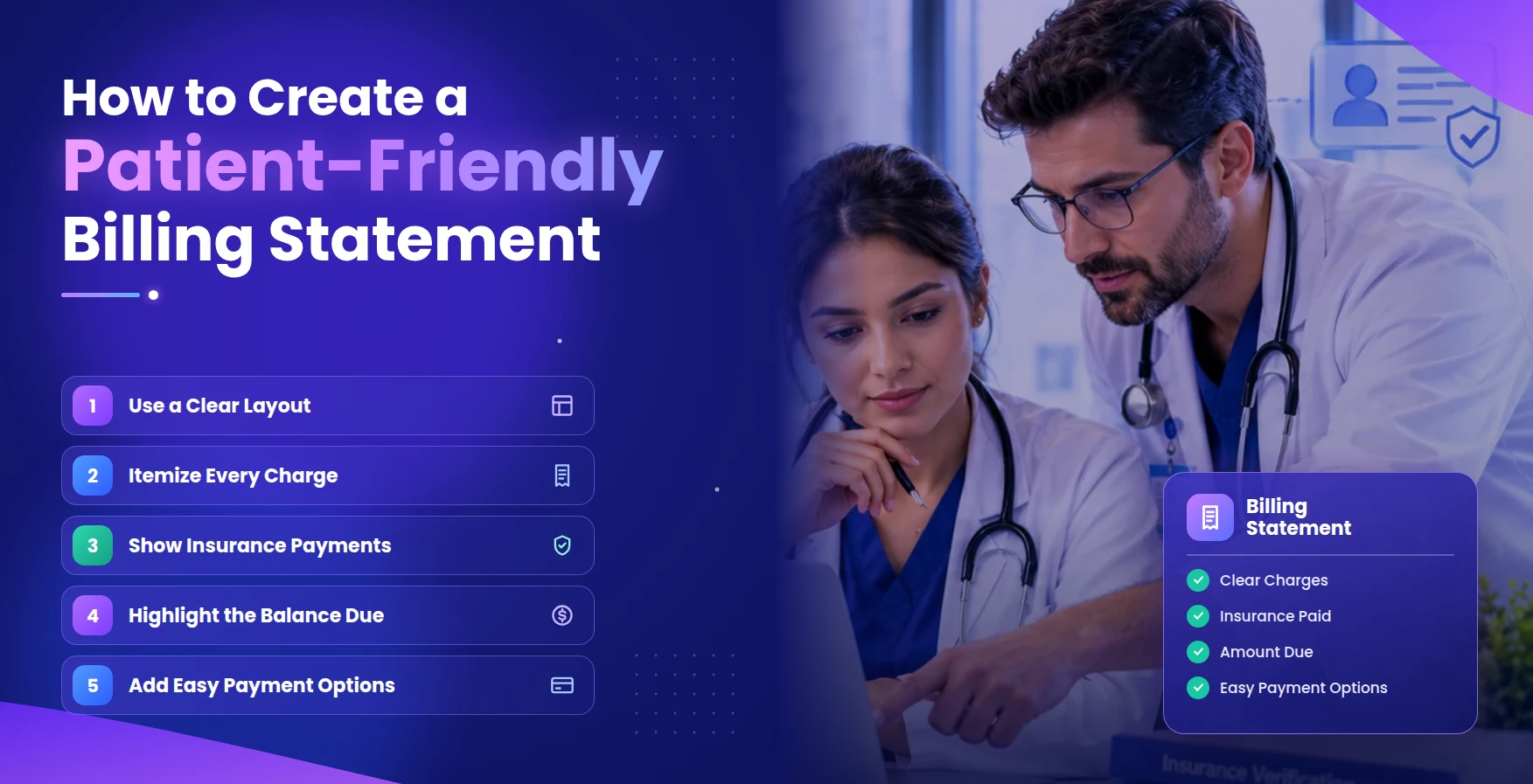

A patient-friendly billing statement explains what was billed, what insurance paid, and what the patient actually owes in plain language, without requiring the patient to decode CPT codes or contractual adjustment jargon. HFMA’s long-running Patient Friendly Billing initiative frames this as a matter of clarity, conciseness, and correctness. Getting it right shortens the distance between a statement going out and payment coming back, and reduces the calls that land on medical billing staff asking what a bill even means.
What Makes a Billing Statement Patient-Friendly?
A patient-friendly statement uses plain language rather than billing codes and jargon, clearly separates what insurance paid from what the patient owes, and states a specific, actionable next step for payment.
What Organization Sets the Standard for Patient-Friendly Billing?
HFMA’s Patient Friendly Billing project, part of its broader Patient Financial Communications best practices, is the leading industry framework for clear, concise, and correct billing statements.
Does a Billing Statement Need to Include a Cost Estimate?
A billing statement itself is not the same as a Good Faith Estimate, but under the No Surprises Act, uninsured and self-pay patients must separately receive a Good Faith Estimate before certain services.
How Should Patient Responsibility Be Presented?
Patient responsibility should be shown as one clear total, broken into its components only as needed for transparency, not buried inside a dense table of codes.
Key Takeaways
- A patient-friendly statement replaces billing codes and jargon with plain-language descriptions of what was billed and paid.
- HFMA’s Patient Friendly Billing project is the industry’s long-standing reference for clarity, conciseness, and correctness in billing communication.
- The No Surprises Act requires a separate Good Faith Estimate for uninsured or self-pay patients before many scheduled services.
- The clearest statements show one total patient-responsibility amount up front, with supporting detail available but not the headline.
- A specific, actionable next step for payment, not just a balance due, reduces confused calls and speeds collection.
- A practice that pairs clear statements with proactive patient eligibility verification tends to see fewer surprise balances reach the statement stage at all.
Why Does Patient-Friendly Billing Matter for Collections?
As patients carry a growing share of their own healthcare costs, a statement they cannot understand is a statement they are unlikely to pay promptly, regardless of whether the underlying charge is entirely correct. This matters across every specialty but especially in med spa and aesthetics practices with a significant self-pay or cosmetic-service patient base.
What Does HFMA’s Patient Friendly Billing Framework Emphasize?
The framework centers on three qualities: clarity, the patient can understand what they owe and why, conciseness, the statement is not overloaded with unnecessary detail, and correctness, the amount billed reflects what insurance has already processed.
What Are the Key Elements of a Patient-Friendly Billing Statement?
The ten points below cover the design choices that separate a clear statement from a confusing one.
Lead With the Amount Owed, Not the Billed Charge
The most prominent number on the statement should be what the patient actually owes today, not the full billed charge before insurance adjustments. Leading with an inflated gross charge, even when clearly not the final balance, causes confusion and unnecessary alarm.
Translate Codes Into Plain Descriptions
Replace or supplement raw CPT and diagnosis codes with a plain-language description of the service, such as “office visit” or “lab test” rather than only a five-digit code the patient has no way to interpret.
Separate What Insurance Paid From What the Patient Owes
Show the billed amount, the insurance payment, any contractual adjustment, and the resulting patient responsibility as distinct, clearly labeled lines, so the patient can see the math rather than just the final number.
Avoid Unexplained Billing Jargon
Terms like “contractual adjustment” or “non-covered charge” mean nothing to most patients without a brief plain-language explanation alongside them. A short glossary or footnote goes a long way.
State a Specific, Actionable Next Step
Tell the patient exactly what to do: pay online at a specific link, call a specific number with specific hours, or set up a payment plan through a specific process. A vague balance due with no clear path stalls payment.
Offer Multiple Payment Options
List the ways a patient can pay: online portal, phone, mail, or in person, since forcing every patient through a single channel adds friction that delays payment for no clinical or financial reason.
Keep the Statement Visually Uncluttered
Use generous white space, a clear visual hierarchy, and limit the statement to what the patient actually needs to understand and act on; a dense, code-heavy table format works against the goal even when every number on it is accurate.
Connect the Statement to Any Prior Estimate
For uninsured or self-pay patients who received a Good Faith Estimate under the No Surprises Act before service, the final statement should be reconcilable against that estimate. A substantially higher bill triggers a patient’s right to dispute it through the federal Patient-Provider Dispute Resolution process.
Provide a Way to Ask Questions Easily
Include a direct phone number or contact method specifically for billing questions, staffed by people trained to explain the statement in plain terms, not just process a payment.
Test the Statement With Real Patients
The clearest way to know whether a statement is actually patient-friendly is to have someone outside billing, ideally an actual patient or a colleague unfamiliar with the account, read it and explain back what they think they owe and why.
When Should a Statement Include a Payment Plan Offer Upfront?
Offer a payment plan option directly on the statement for larger balances, rather than making the patient call in and ask whether one exists; surfacing the option proactively increases the odds a patient engages instead of ignoring the bill entirely.
When Is a Phone Call Better Than a Mailed Statement Alone?
A phone call, or at minimum a clear invitation to call, works better than a statement alone for large or unexpected balances, where a patient is more likely to have questions a printed page cannot fully anticipate.
Best Practices for Patient-Friendly Billing Statements
- Lead with the amount owed today, not the full pre-adjustment billed charge.
- Translate every code into a plain-language service description.
- State one clear next step for payment, with multiple ways to actually complete it.
- Reconcile the final statement against any Good Faith Estimate the patient previously received.
- Test the statement’s clarity with someone outside the billing department before finalizing the template, and confirm the design still supports accurate payment posting once payments start coming in.
Mistakes to Avoid With Patient Billing Statements
- Leading with the full billed charge instead of the actual patient responsibility, causing unnecessary alarm.
- Using unexplained billing jargon or raw procedure codes with no plain-language translation.
- Sending a statement that contradicts a prior estimate without explanation, undermining trust the practice built during intake.
- Offering only one payment channel, adding friction that delays collection.
- Providing no clear, staffed contact point for billing questions.
Illustrative Documentation Example
The scenario below is a hypothetical example for teaching purposes, not an actual patient billing case.
A patient receives a statement showing a $1,200 billed charge, a $950 insurance payment, and a $250 patient responsibility, each labeled in plain language with a one-line explanation of the contractual adjustment. The statement offers online, phone, and mailed payment options and a direct number for billing questions, and the patient pays online within a week rather than calling to ask what the bill means.
Conclusion
A patient-friendly billing statement is not about softening a real balance; it is about making that balance understandable at a glance so the patient can act on it without a phone call to decode it first. HFMA’s clarity-conciseness-correctness framework, paired with the transparency the No Surprises Act now requires for self-pay patients, gives practices a concrete standard to design against. A practice redesigning its statement templates often pairs the effort with a broader look at old AR and backlog recovery, since a clearer statement is often the fastest way to shrink an aging patient balance.
FAQs
Is a patient-friendly billing statement legally required?
There is no single federal mandate specifying statement design, though the No Surprises Act’s Good Faith Estimate requirements for self-pay patients create a related transparency obligation; patient-friendly design itself is an industry best practice.
How is a billing statement different from a Good Faith Estimate?
A Good Faith Estimate is provided before service to an uninsured or self-pay patient under the No Surprises Act, while a billing statement is issued after service reflecting what was actually billed and paid.
Should a billing statement show the full list of CPT codes?
Codes can be included for reference, but they should be paired with a plain-language description; showing codes alone without translation defeats the purpose of a patient-friendly design.
What is HFMA’s Patient Friendly Billing project?
It is HFMA’s long-running initiative promoting clear, concise, and correct patient financial communications, including billing statement design.
Does a clearer statement actually improve collection rates?
A practice that has adopted clearer, plain-language statement designs generally reports fewer confused billing calls and faster patient payment, though results vary by patient population and the specific design changes made.