
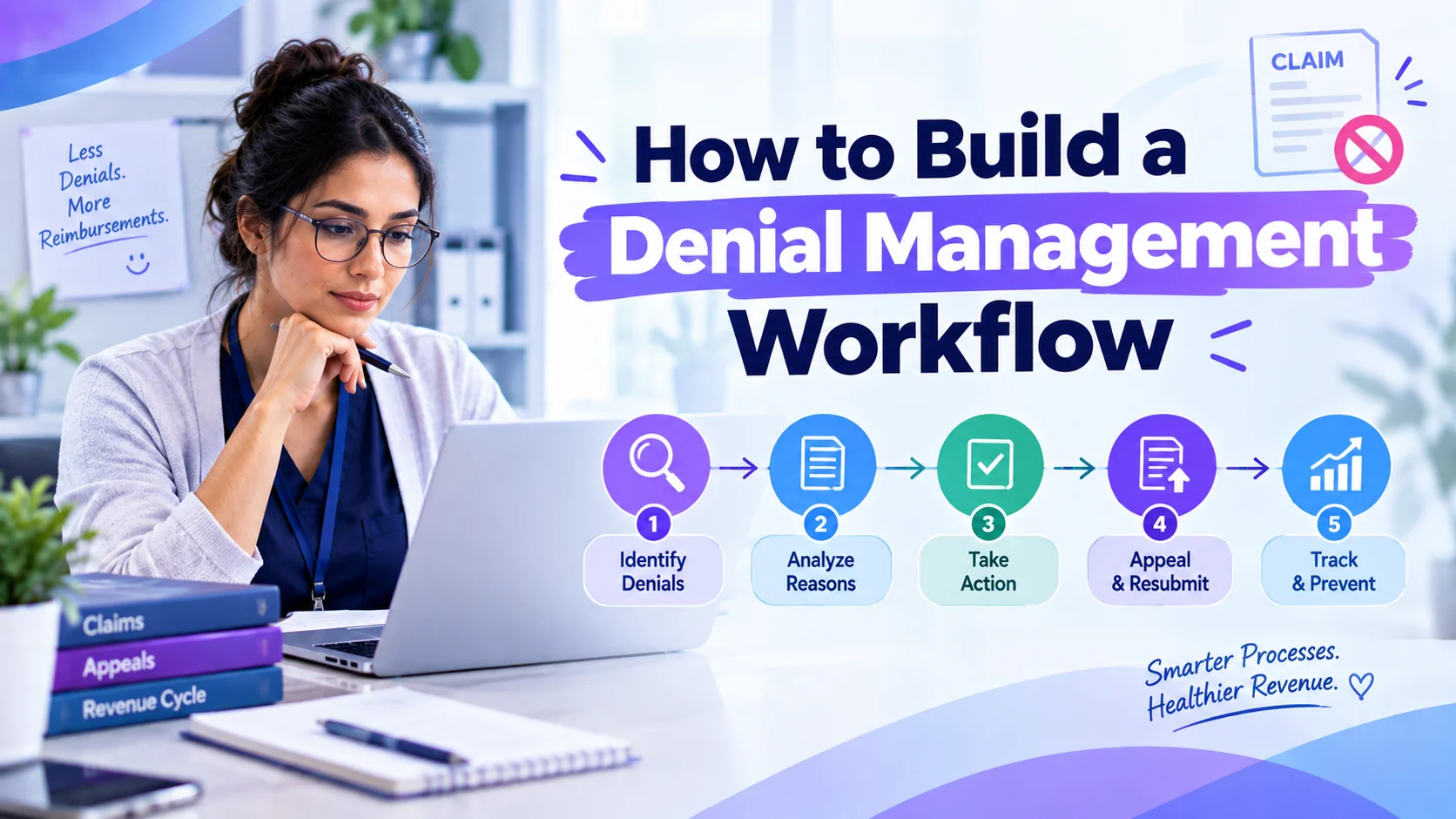

A denial management workflow is the repeatable process a practice uses to capture every denied claim in one place, work out why the payer refused it, correct or appeal it, and feed the cause back into the stage that created it. Done well, it does two jobs: recover dollars already denied, and shrink how many claims land in that queue next month. A practice without a structured denial management process tends to work denials reactively, one at a time.
What Is a Denial Management Workflow?
A denial management workflow is the structured, repeatable process for identifying denied claims, assigning ownership, correcting or appealing them, tracking payer responses, and feeding root causes back into the upstream process that caused the denial.
What Is the Difference Between a Rejection and a Denial?
A rejection is caught before the payer adjudicates the claim, usually a formatting or data error at the clearinghouse. A denial arrives after the payer has processed and formally refused the claim, and follows a different resolution path.
How Should Denied Claims Be Tracked?
In a single, centralized intake queue that pulls from every source, electronic remittance advice feeds, payer portals, and paper explanation-of-benefits documents, rather than being scattered across separate inboxes and logins.
What Is the Most Overlooked Step in Denial Management?
Feeding the root cause of a resolved denial back into the upstream stage responsible for it, rather than treating each denial as a closed, isolated event once it is paid or written off.
Key Takeaways
- A denial management workflow has two goals at once: recovering denied revenue and preventing the same denial from recurring.
- Centralizing intake from every remittance source into one queue is the foundation the rest of the workflow depends on.
- Denials should be triaged by CARC/RARC code and routed to the team member best positioned to fix that specific issue.
- Root-cause analysis, not just individual claim correction, is what actually lowers a practice’s denial rate over time.
- Appeal deadlines are payer-specific and generally much shorter than the original claim filing window, so timing discipline matters.
- A denial dashboard tracking appeal aging, overturn rate, and write-off triggers turns denial management from a reactive task into a measurable program.
Why Build a Formal Denial Management Workflow?
Without a structured process, denials get worked inconsistently, whoever has time that day picks up whatever claim is on top, with no tracking of which denials keep recurring or why. HFMA’s research on denial root causes points to exactly this gap. A formal workflow turns that scattered effort into a measurable program with clear ownership, which matters most in multi-specialty group practice settings where denial patterns can differ meaningfully by specialty and payer.
Who Should Own the Denial Management Workflow?
Ownership works best when split deliberately: someone owns intake and triage, someone owns the appeals queue itself, and someone else owns root-cause analysis and feeding fixes back upstream. Combining the appeals queue and root-cause analysis into one role tends to mean the appeals queue wins every time and the analysis never happens.
What Are the Key Steps in a Denial Management Workflow?
The ten points below walk through building the workflow from intake to prevention.
Step One: Centralize Intake From Every Source
Pull denials daily from every channel: clearinghouse 835/ERA feeds, payer portal remittances, direct portal logins for payers without electronic delivery, and paper explanation-of-benefits documents. Denial work fails at the very first step when these sources are not consolidated into one place.
Step Two: Classify Every Denial by CARC and RARC
Log each denial by its Claim Adjustment Reason Code and, where applicable, its paired Remittance Advice Remark Code, rather than a free-text description. This is what makes the data usable later for spotting patterns.
Step Three: Distinguish Rejections From True Denials
Route rejected claims, which never reached payer adjudication, back to the correction-and-resubmission path immediately. True denials need investigation first, since the payer has already made a decision that must be either corrected or formally appealed.
Step Four: Assign Ownership by Denial Type
Route eligibility and demographic denials to front-office staff, coding and medical necessity denials to coders, and documentation-related denials to clinical staff or a liaison who can pull the chart. A denial sitting unassigned in a shared queue is a denial nobody actually owns.
Step Five: Correct and Resubmit or Appeal
For a coding or data error, correct the specific field and resubmit as a corrected claim. For a coverage or medical necessity dispute where the documentation genuinely supports the service, file a formal appeal with the supporting chart notes attached, within the payer’s specific appeal deadline.
Step Six: Track Every Denial to a Final Outcome
Maintain a record of the payer follow-up date, the next action, the assigned owner, the final outcome, and the paid amount versus the original billed amount. An unresolved denial sitting untracked past its filing or appeal deadline converts into a permanent write-off.
Step Seven: Calculate the Core Denial Metrics
Track the denial rate, the appeal overturn rate, average days to resolution, and the write-off rate. These four numbers together show whether the workflow is actually working, not just busy.
Step Eight: Run Root-Cause Analysis Separately From Appeals Work
Set aside dedicated time, not leftover time after the appeals queue is cleared, to review denial patterns by procedure code, diagnosis, provider, and payer. The goal is writing the root cause specifically enough that someone can act on it.
Step Nine: Feed Fixes Back Into the Upstream Process
A recurring CO-11 pattern tied to one procedure code should become a coding reference update. A recurring CO-16 pattern tied to missing authorization numbers should become a front-desk checklist item. The workflow is not complete until the fix lands upstream.
Step Ten: Review the Denial Dashboard on a Regular Cadence
A monthly or biweekly review of the denial dashboard, broken out by CARC, payer, and provider, catches a new or worsening pattern early, before it compounds across a full billing cycle’s worth of claims.
When Should a Claim Be Appealed Instead of Simply Corrected?
Appeal when the underlying documentation genuinely supports the service but the payer’s coverage policy or medical necessity determination disputes it. Correct and resubmit instead when the issue is a data, coding, or formatting error the practice can fix directly.
When Should a Denial Be Written Off Instead of Pursued?
Write off a denial when the cost and likelihood of a successful appeal genuinely do not justify the staff time required, a deliberate decision tracked in the workflow, not a default outcome from a claim simply aging out untouched. A practice with heavy old AR and backlog recovery needs often finds a large share of aged denials were never formally worked at all.
Best Practices for a Denial Management Workflow
- Centralize every denial source into a single daily intake queue rather than working from scattered logins.
- Classify denials by CARC/RARC from day one so patterns become visible in the data, not just in memory.
- Separate the appeals-working role from the root-cause-analysis role so neither one crowds out the other.
- Track appeal deadlines by payer explicitly, since they are typically shorter and stricter than the original filing window.
- Review the denial dashboard on a fixed cadence rather than only when someone happens to notice a problem.
Mistakes to Avoid When Building a Denial Management Workflow
- Working denials reactively, whoever has time picks up whatever is on top, with no tracking of recurring patterns.
- Combining appeals work and root-cause analysis into one role, where the appeals queue always wins the time.
- Letting denials age past the appeal deadline while sitting in an untracked queue instead of active accounts receivable management.
- Fixing individual claims without ever feeding the pattern back into the upstream process that caused them.
- Measuring only total dollars recovered instead of the denial rate, overturn rate, and days-to-resolution that show whether prevention is actually working.
Illustrative Documentation Example
The scenario below is a hypothetical example for teaching purposes, not an actual patient billing case.
A practice notices CO-16 denials tied to missing prior authorization numbers spiking for one specific procedure. Instead of only correcting each claim as it comes in, the denial management team traces the pattern to a scheduling step where authorization confirmation was being skipped for that specific service. Adding a mandatory authorization check to the scheduling workflow for that procedure code resolves the pattern within a month.
Conclusion
A denial management workflow only pays off fully when it does both jobs at once: recovering what is already denied, and feeding what it learns back into the upstream process that caused the denial in the first place. Skipping the second half means working the same denials indefinitely instead of shrinking the queue. A practice with a persistent denial pattern often brings in a medical billing audit specifically to separate root-cause analysis from the day-to-day appeals grind.
FAQs
How quickly should a denial be worked after it arrives?
As soon as possible, ideally within a few business days, since appeal deadlines are typically much shorter than original claim filing windows and denials worked quickly are generally easier to resolve than ones left to age.
What is a reasonable target denial rate?
There is no universal target, but many organizations aim to keep first-pass denial rates in the single digits; the more meaningful benchmark is tracking your own practice’s trend over time rather than chasing an external number.
Should every denial be appealed?
No. Some denials reflect a genuine coding or data error best resolved with a simple correction, and some are not worth the staff time to pursue given the dollar amount and likelihood of success.
How does denial management connect to the rest of the revenue cycle?
Denial management sits toward the back of the cycle chronologically but exists to feed information backward into scheduling, eligibility, coding, and documentation.
What tools help centralize denial intake?
Clearinghouse 835/ERA feeds, payer portal integrations, and a shared denial-tracking system or worklist are the core building blocks; the specific software matters less than making sure every denial source actually lands in one place.